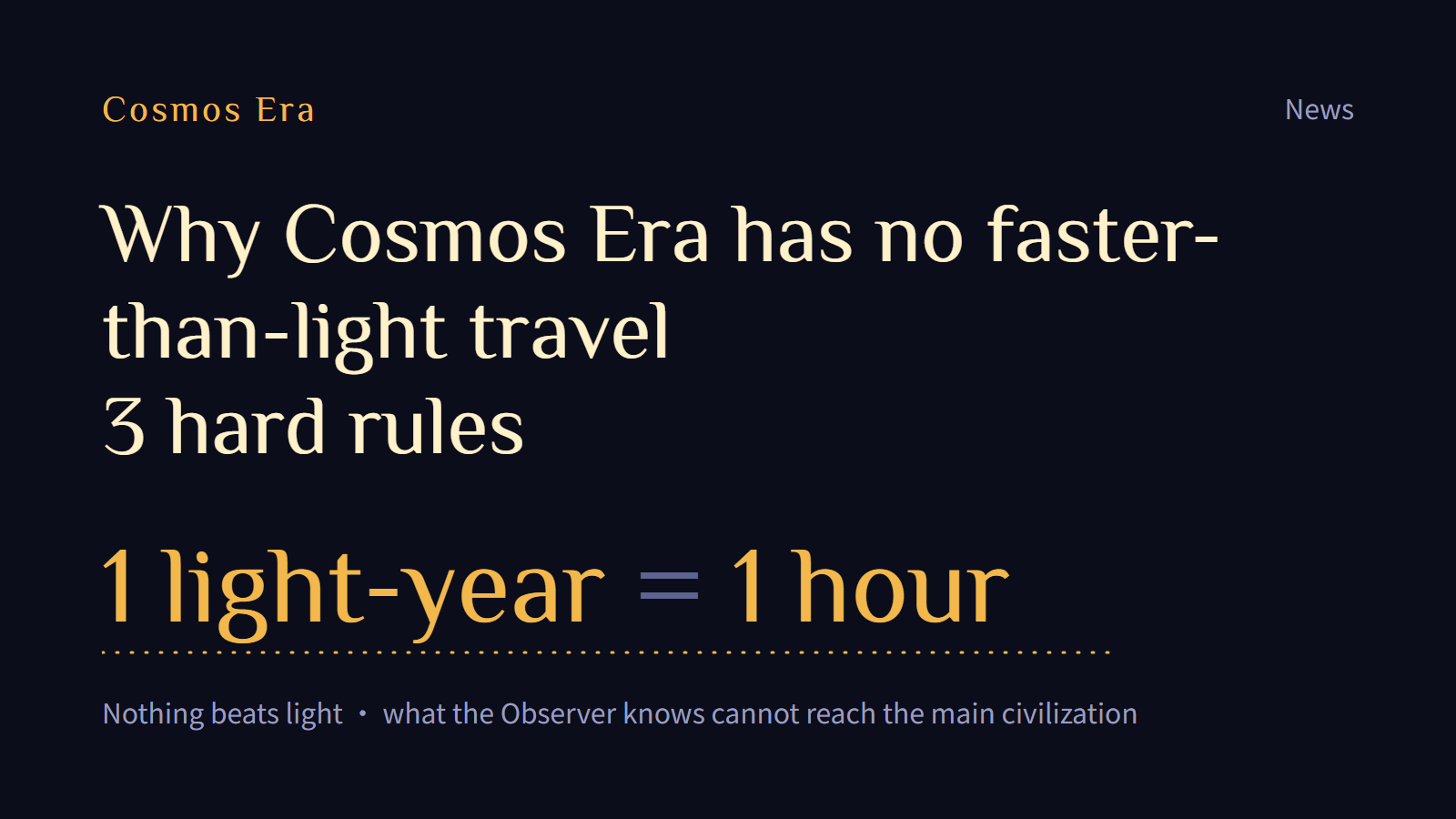
Why Cosmos Era has no faster-than-light travel: 3 hard rules
Cosmos Era has three rules: 1 light-year takes 1 real hour, no faster-than-light travel, and the Observer can't tell the main civilization directly.
Cosmos Era is a hard sci-fi game, so it has three rules that never bend: 1 light-year = 1 hour of real time; faster-than-light travel is never allowed; and what the Observer knows can't be told directly to the main civilization. This post explains each rule, why it exists, and what it changes in the game.
Rule 1: 1 light-year = 1 real hour
Distances in the game turn straight into waiting time. Proxima Centauri b is 4.24 light-years away, so a signal there and back takes several real hours. Tau Ceti is 11.9 light-years away, so you wait longer. K2-18 b is 124 light-years away.
- Signals, probes and weapons all move at speeds set by this ratio and by real physics.
- Civilizations more than 100 million light-years away (the Expanders and the Aestivators) run on the "cosmic clock", and the interface says so.
This rule makes "far" something you can feel. You don't click and arrive. You wait for the light to cross the gap.
Rule 2: faster-than-light travel is never allowed
There is no warp drive and no instant messaging in the game. To go far, you can only travel below light speed.
- A wormhole has to be towed to its destination at sub-light speed before it connects anything.
- No civilization and no weapon can outrun light.
This rule gives every expedition a cost. The farther the target, the longer it takes and the earlier you have to plan.
Rule 3: the Observer sees the present, the main civilization sees the past
The game has two points of view:
- The Observer sees the universe as it is right now.
- The main civilization sees the past. If a civilization is d light-years away, the main civilization always sees it d hours late.
What the Observer knows can't be passed directly to the main civilization. The main civilization has to find things out with its own telescopes, probes and reasoning, one step at a time. This rule keeps discovery a process.
What the three rules do together
Stacked together, the rules give information in the game a direction and a delay. You always see the past. A signal you send gets an answer only after the light has made the trip. No shortcut gets around physics.
This is also why every civilization channel is unlocked by discovery. How far away each one is and when it can be seen both depend on clear conditions.
How real and fictional are kept apart
The three rules cover what is physically impossible. Which content is real science and which is game lore is a separate set of rules, covered in Real basis and game lore: how Cosmos Era tells fact from fiction.
More Posts

Cosmos Era is now playable in your browser
A hard sci-fi idle game from the Big Bang to an interstellar civilization. Play it in your browser, or install it on your phone's home screen and play offline.

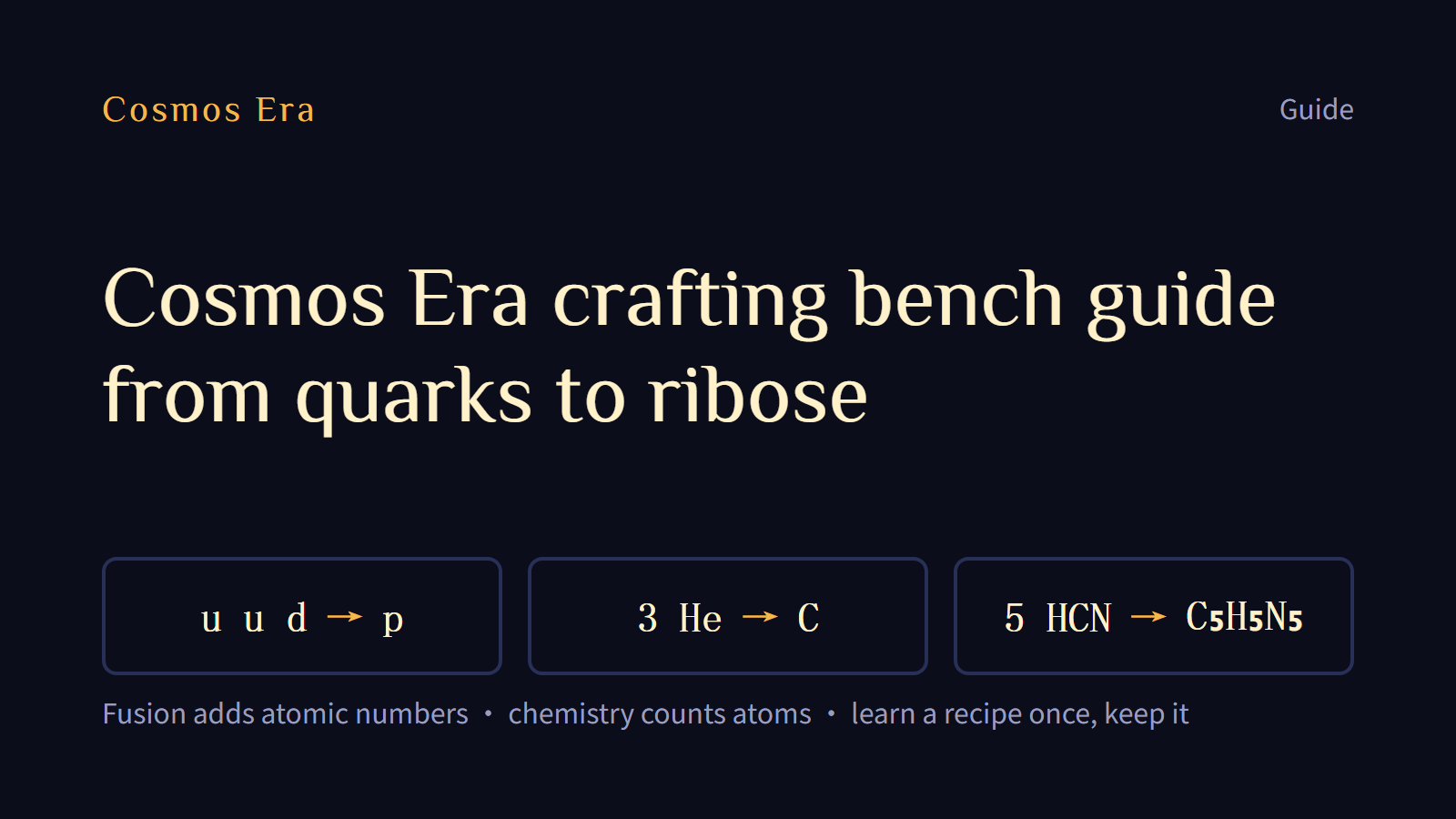
Cosmos Era crafting bench guide: from quarks to ribose
Crafting bench guide: nuclear reactions add atomic numbers, chemistry conserves atoms. 51 recipes, learned once, then auto-crafted in each new universe.
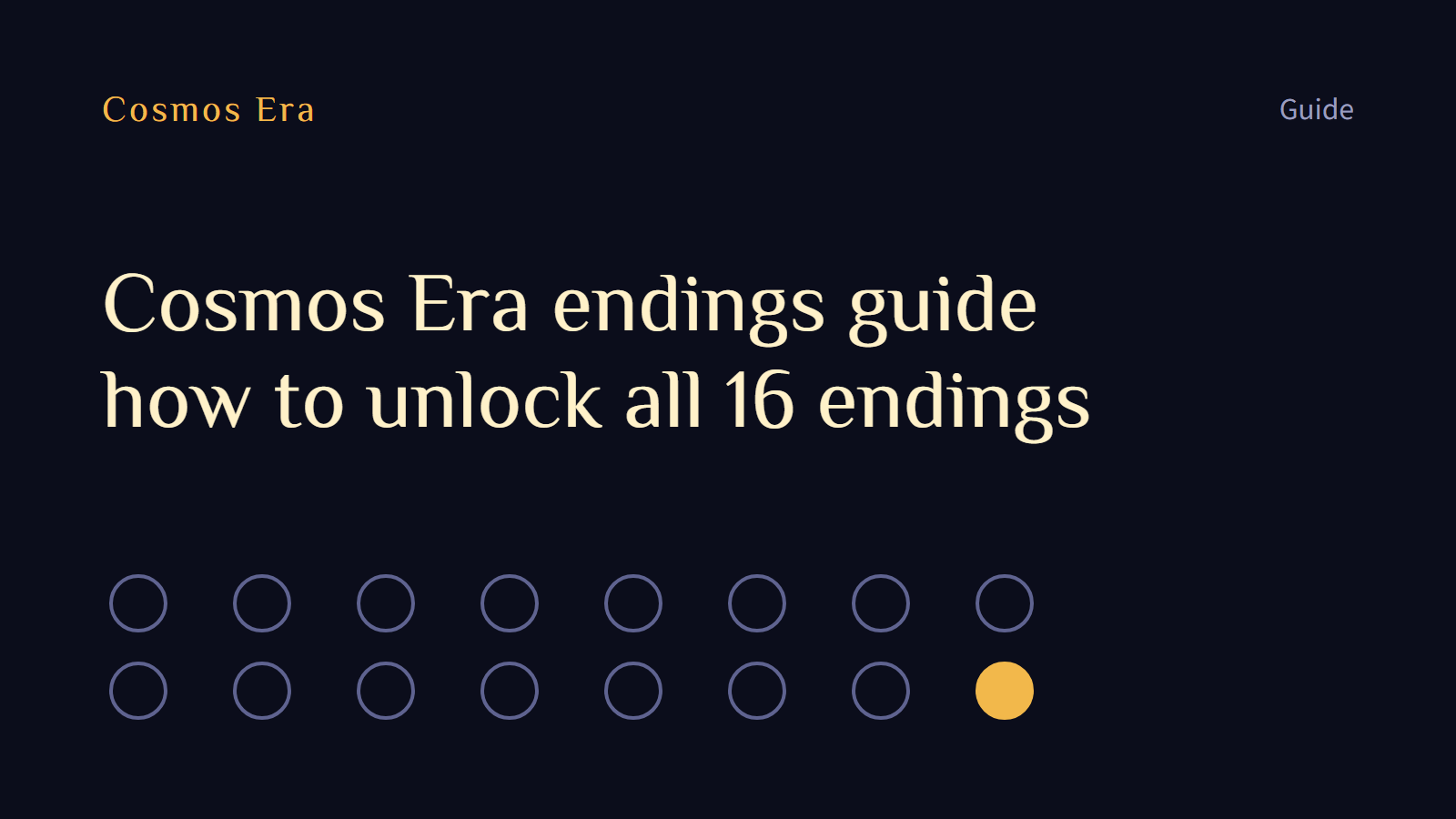
Cosmos Era endings guide: how to unlock all 16 endings
Conditions and hints for all 16 Cosmos Era endings. Most need one node plus the end of the universe; some need other endings first; the last needs the rest.