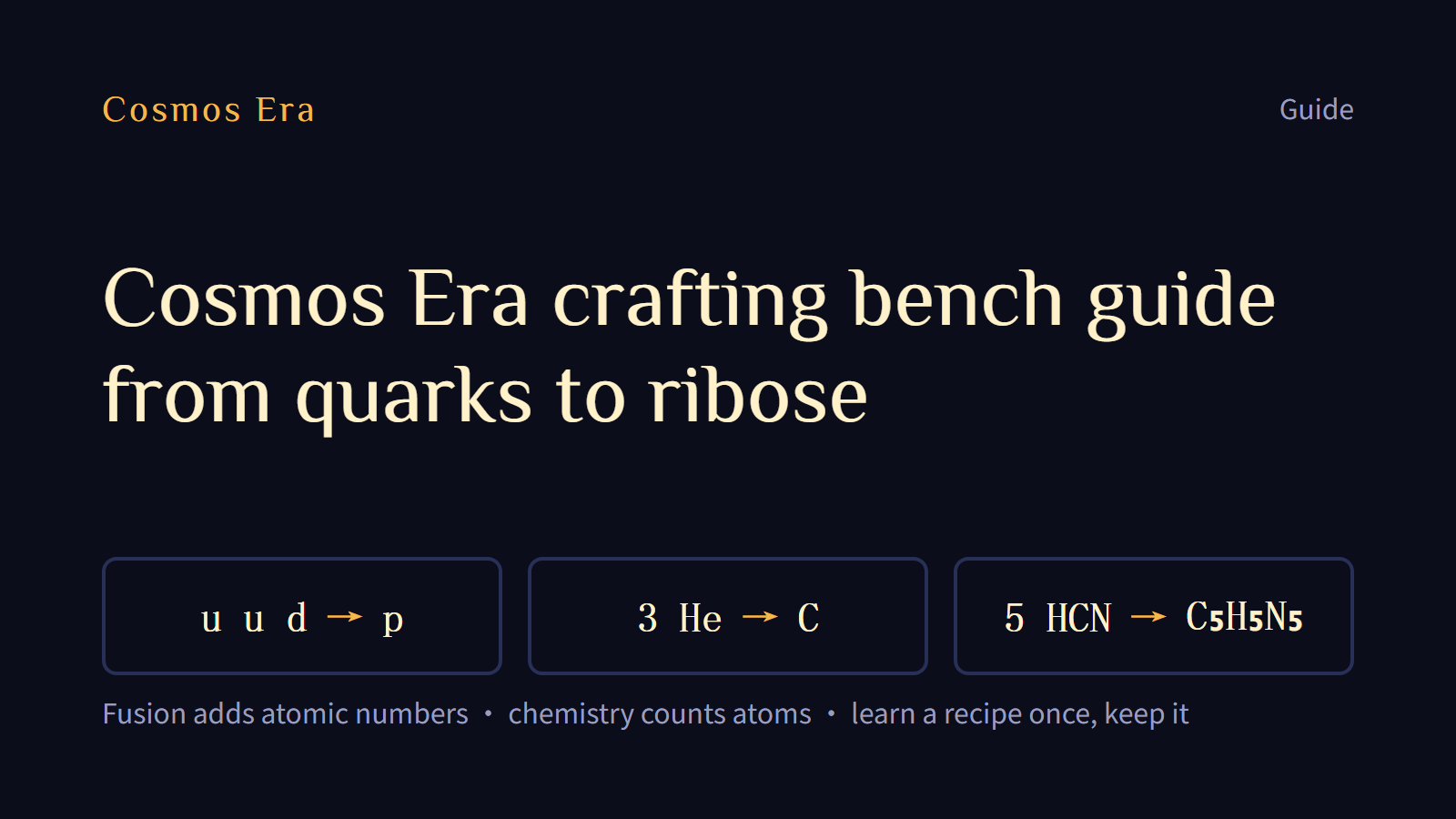
Cosmos Era crafting bench guide: from quarks to ribose
Crafting bench guide: nuclear reactions add atomic numbers, chemistry conserves atoms. 51 recipes, learned once, then auto-crafted in each new universe.
The crafting bench is a separate button that appears once you unlock your first quark. It turns 51 nodes of the Tree of Matter into recipes: 4 hadrons, 26 elements and 21 molecules. You craft each one by hand the first time. After one success, the game remembers it for good and crafts it automatically in every new universe.
Rules
- The first time: put the ingredients into the crafting bench and tap "Craft". If it's right, the node unlocks and you get 1 time crystal.
- After that: learned recipes carry over across rebirths. In a new universe, as long as the cost is no more than 25% of your current resources, the game crafts it for you, with no need to rebuild it. It doesn't auto-craft while you're offline, like other automation.
- If a recipe is right but the era hasn't arrived, a prerequisite isn't unlocked or you lack resources, the recipe is still remembered and crafts automatically once the conditions are met.
- Nodes outside these 51 (elements heavier than nickel, most biomolecules, the Tree of the Cosmos and so on) are still unlocked directly.
The crafting bench has two modes. The same ingredients combine differently under different physics: carbon plus oxygen gives silicon in a nuclear reaction, and carbon monoxide in a chemical reaction.
Nuclear reactions: count quarks, add atomic numbers
Once you complete the "Hadron epoch" in the Particle era, the first recipes appear. The beginner tutorial teaches the first one: 2 up quarks plus 1 down quark make a proton.
Quarks: an up quark has charge +2/3 and a down quark −1/3. A proton has charge +1 and a neutron has none, so you can work out how many up and down quarks each needs.
Atomic nuclei:
- 1 proton is a hydrogen nucleus.
- 2 protons plus 2 neutrons make a helium nucleus. You can also use 4 hydrogens, which is how the Sun burns (the proton–proton chain).
- After that, elements combine by adding atomic numbers. 3 helium (No. 2) make carbon (No. 6), the triple-alpha process that really happens inside stars. Carbon plus helium gives oxygen (No. 8). 2 carbon give magnesium (No. 12), called carbon burning. 2 oxygen give sulfur (No. 16). 2 silicon (No. 14) give nickel (No. 28), called silicon burning.
When a combination fails, the hint is also real physics:
- Only 2 hydrogens: two hydrogen nuclei repel each other, so do it the Sun's way with 4.
- Helium plus helium: you get beryllium-8, which lasts only about 10⁻¹⁶ seconds before it breaks back into two helium. Beryllium and boron in the universe come from cosmic rays smashing larger nuclei, so you can't craft them on the bench.
- Atomic numbers adding up to more than 28: for elements heavier than nickel, fusion costs energy instead of releasing it. They build up slowly through neutron capture in old stars, or appear all at once when neutron stars merge. That is why these elements aren't on the crafting bench.
Chemistry: atoms are conserved
Chemistry mode looks at atoms. Add up how many of each atom are in your ingredients, and if it matches the target molecule's formula exactly, it works. Ingredients can be elements or molecules you've already crafted.
- 2 hydrogen plus 1 oxygen give water.
- 1 hydrogen, 1 carbon and 1 nitrogen give hydrogen cyanide.
- 5 hydrogen cyanide give adenine (C₅H₅N₅). This is a real synthesis route studied in origin-of-life research.
- 5 formaldehyde give ribose (C₅H₁₀O₅), the sugar backbone of RNA.
- Hydrogen cyanide plus water give formamide.
If the hint says "right kinds of atoms, wrong counts", you are only off by the numbers. Go back and count against the formula.
Tips
- The "To solve" list under the crafting bench shows the recipes you can craft right now, with hints: charge for hadrons, atomic number for elements, formula for molecules. Tapping one switches to the matching mode.
- When a star dies, "forging" only unlocks for free the elements whose recipes you have learned. Craft the common elements early and later forging is worth more.
- Each recipe needs to be crafted only once. A few extra minutes in the first run saves effort in every universe after.
Author

Categories
More Posts
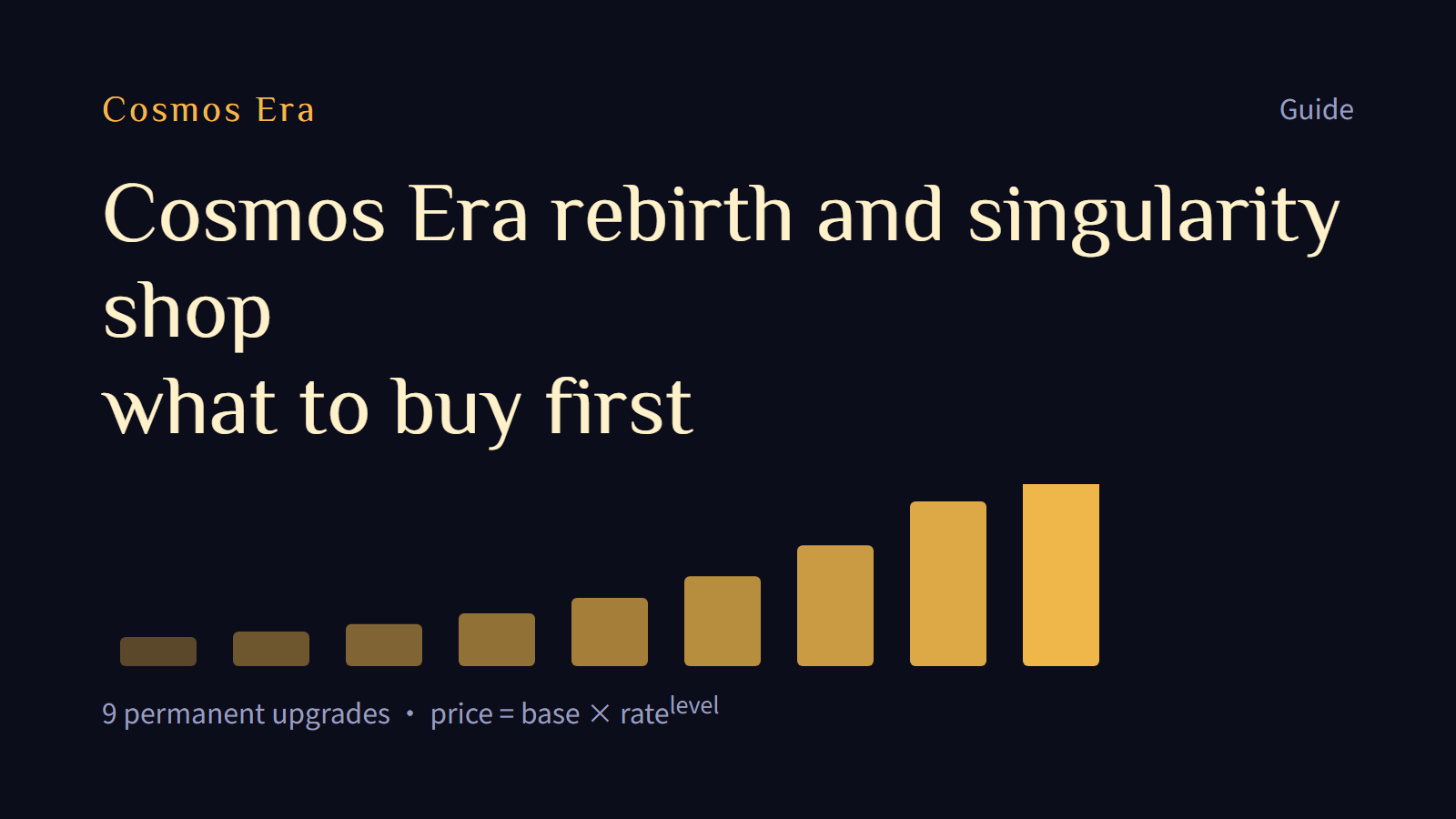
Cosmos Era rebirth and singularity shop: what to buy first
The singularity shop has 9 permanent upgrades. Buy Cosmological constant first, then Whisper of entropy and Memory echo. Price = base price × multiplier^level.
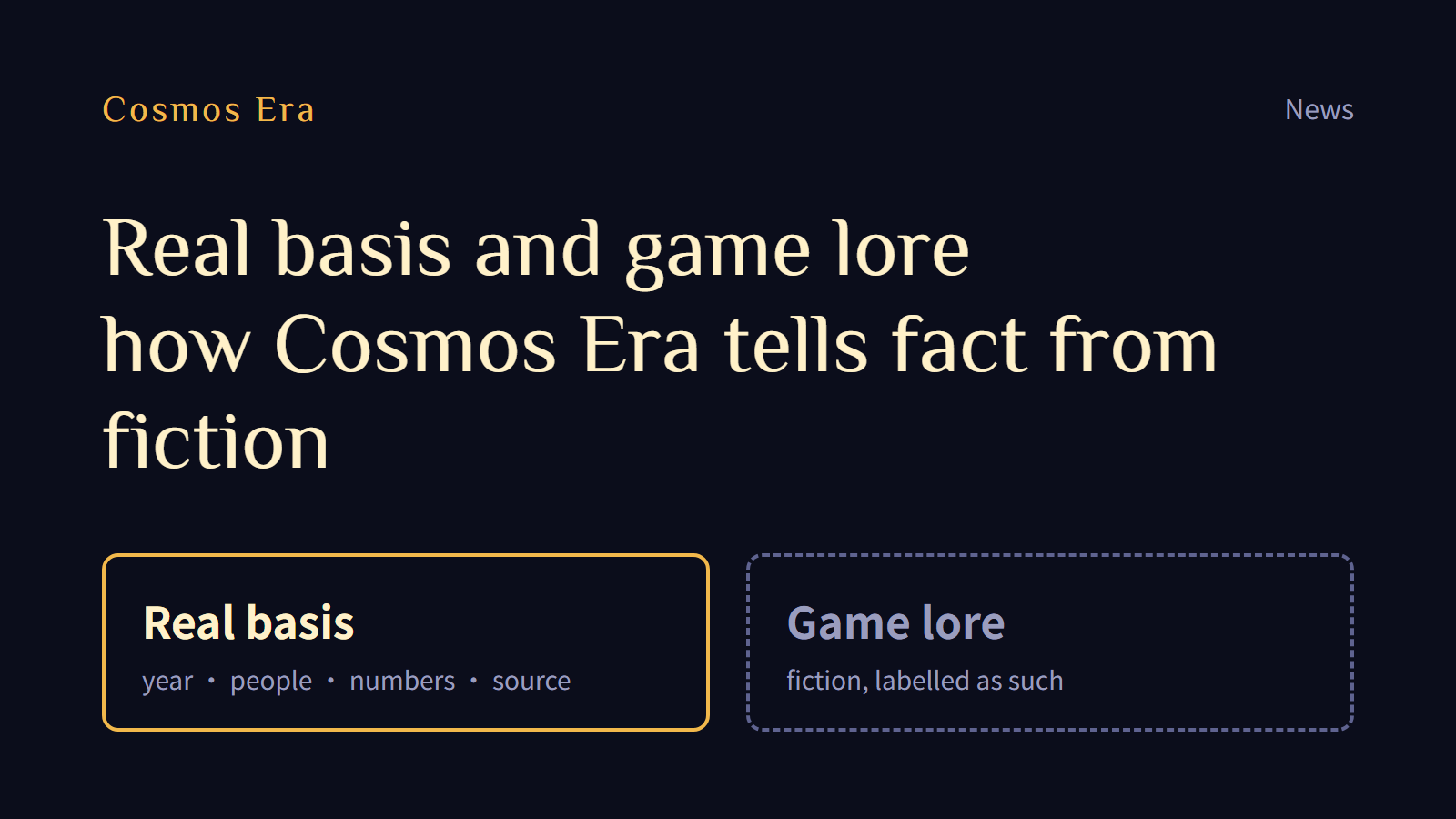
Real basis and game lore: how Cosmos Era tells fact from fiction
Every evolution tree node has two fields, "real basis" and "game lore". The first gives years, names, numbers and sources. The second holds everything invented.
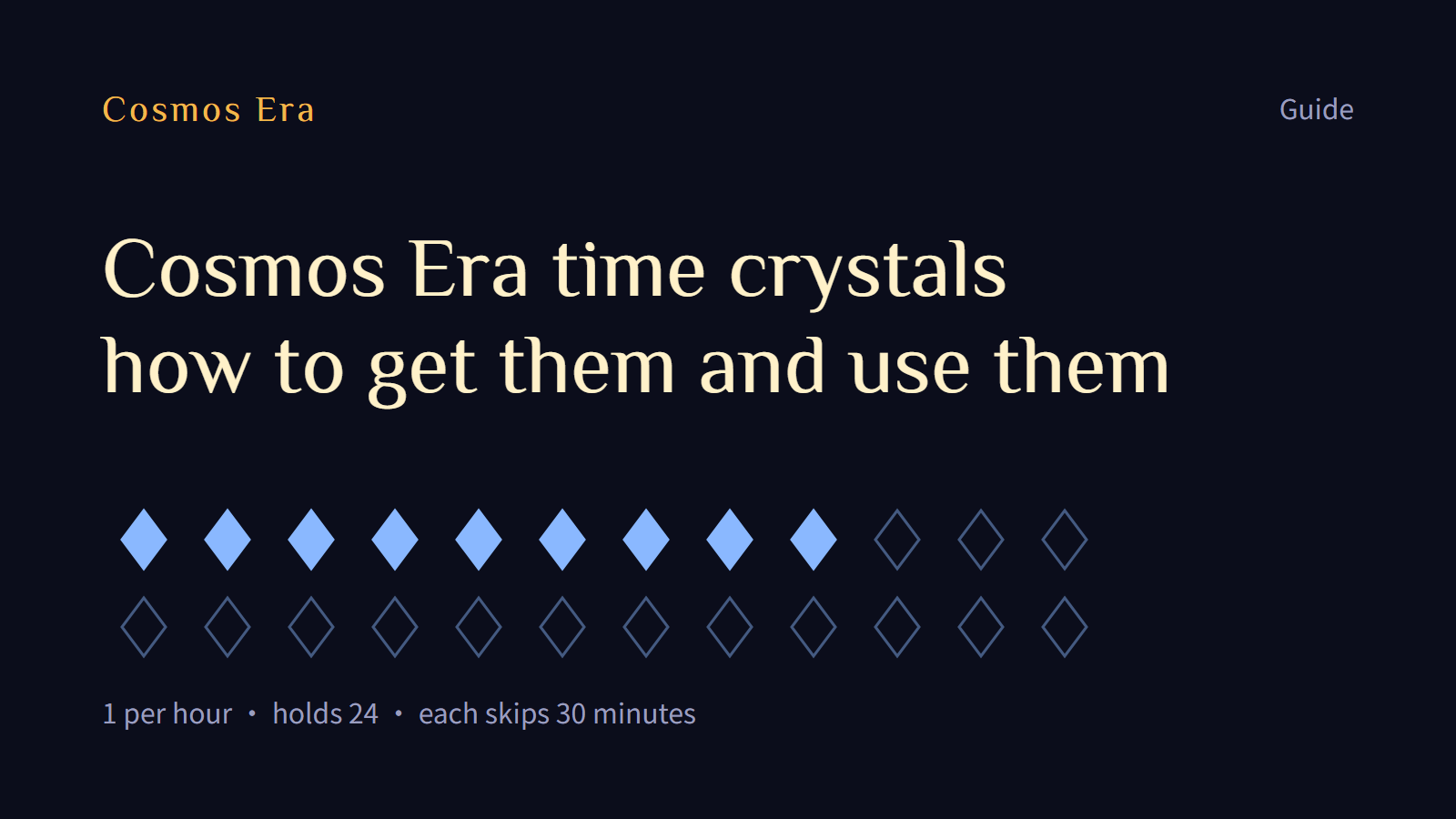
Cosmos Era time crystals: how to get them and use them
A time crystal fast-forwards Cosmos Era by 30 minutes. You earn 1 per hour up to a cap of 24, plus daily goals, rebirths and time capsules you can buy.