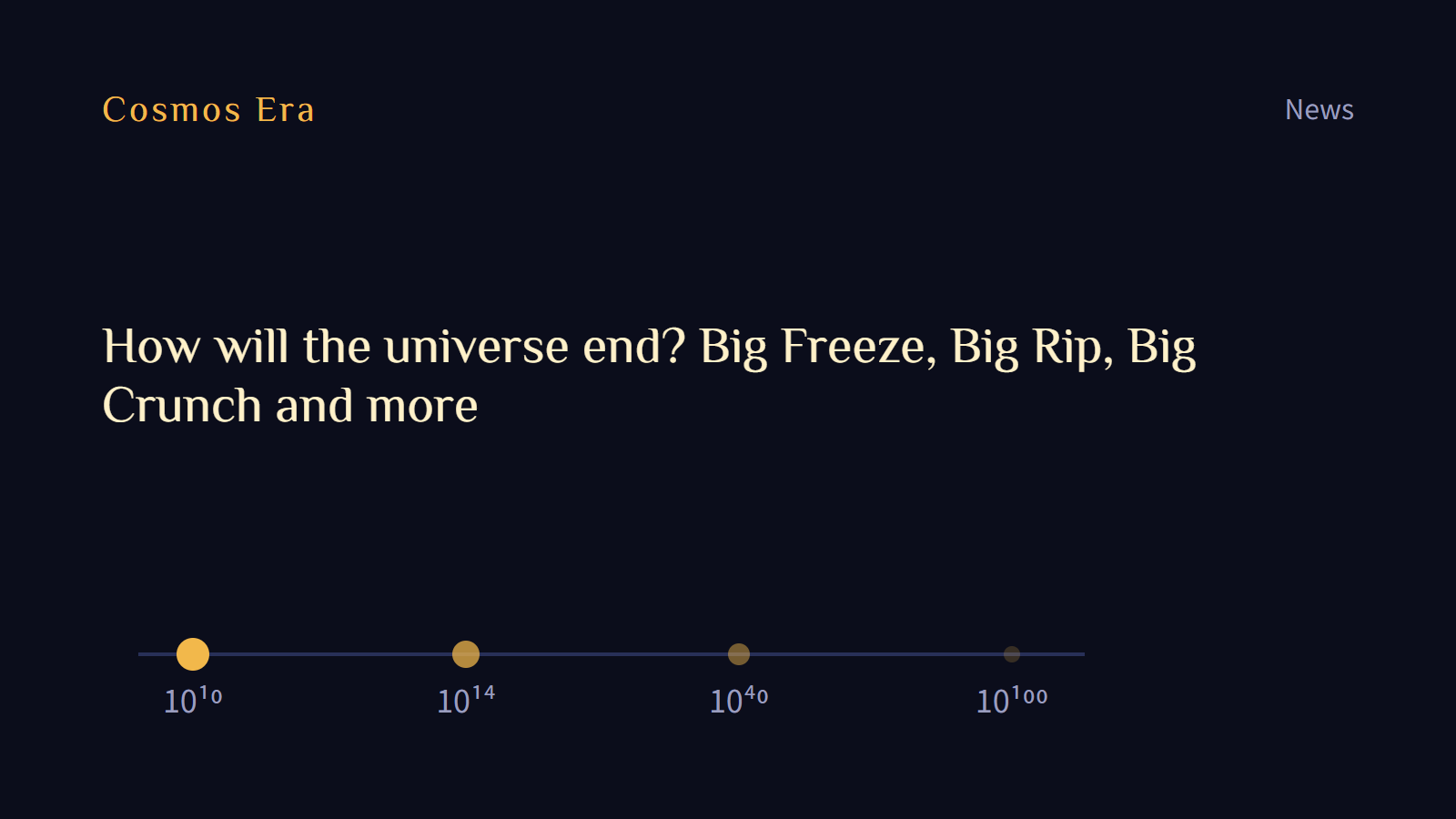
How will the universe end? Big Freeze, Big Rip, Big Crunch and more
How will the universe end? Compare the Big Freeze, Big Rip, Big Crunch, vacuum decay and proton decay: conditions, timescales, and what data favors.
How will the universe end? The best-supported answer today is the Big Freeze, also called heat death: space keeps expanding, the stars burn out, black holes evaporate, and what remains is a thin, cold gas of particles near absolute zero. The reason is that dark energy so far looks like a constant, and the expansion is accelerating with no sign of stopping. The Big Rip, the Big Crunch and vacuum decay each need an extra ingredient that has no evidence yet. Proton decay is a "maybe" inside the Big Freeze: it depends on grand unified theories that nobody has confirmed.
Below, each ending in turn: what it needs, roughly how long it takes, and where the evidence stands.
The five endings side by side
| Ending | What it needs | Roughly when | Evidence today |
|---|---|---|---|
| Big Freeze (heat death) | Dark energy stays about constant; expansion never stops | Last stars go out around 10¹⁴ years; black holes finish evaporating by about 10¹⁰⁰ years | Accelerating expansion is observed; this is the default picture |
| Big Rip | Dark energy that grows stronger ("phantom energy", equation of state w below -1) | Tens of billions of years, depending on w | Not confirmed; data fit w equal to -1 |
| Big Crunch (contraction) | Dark energy turns negative; expansion stops and reverses | No reliable estimate | DESI prefers weakening dark energy, but below 5 sigma |
| Vacuum decay | Our vacuum is metastable and a bubble of true vacuum forms | Expected lifetime about 10¹³⁹ years | Possibly metastable by current measurements; no sign of decay |
| Proton decay | A grand unified theory is right and protons are not stable forever | Proton lifetime at least 10³⁴ years | Never observed |
Big Freeze: the most likely ending
In 1998 Riess and colleagues, and in 1999 Perlmutter and colleagues, used distant supernovae to show that the expansion is accelerating. Dark energy entered physics, and the work won the 2011 Nobel Prize. The Planck satellite's 2018 results give the universe an age of about 13.8 billion years, with ordinary matter at about 5% of the total energy, dark matter about 27%, and the rest dark energy.
If dark energy stays constant, the universe expands forever. Adams and Laughlin traced this path in a 1997 review in Reviews of Modern Physics:
- Stars keep forming until about 10¹⁴ years, then the gas runs out and the last red dwarfs go dark.
- What is left is white dwarfs, neutron stars and black holes, while galaxies slowly disperse.
- Black holes radiate energy through a quantum effect, as Hawking showed in Nature in 1974. Stellar-mass black holes take about 10⁶⁷ years to evaporate; the largest supermassive ones take about 10¹⁰⁰ years.
- After that only very thin photons, neutrinos and electrons remain, cooling toward absolute zero with no energy differences left to do work. That is heat death.
This route needs no new physics, only that today's model keeps holding. That is why it is the default.
Big Rip: dark energy that keeps growing
Caldwell, Kamionkowski and Weinberg proposed in Physical Review Letters in 2003 that if dark energy has an equation of state w below -1 (they called it phantom energy), its density rises over time. The expansion gets faster and faster, tearing apart galaxy clusters first, then galaxies, stars, planets, and finally atoms. Their examples come out at tens of billions of years, depending on the value of w.
Current measurements are consistent with w equal to -1 and nobody has confirmed w below -1. The Big Rip is a carefully calculated possibility without evidence behind it.
Big Crunch: the universe contracts
A Big Crunch needs dark energy to turn negative. Then the expansion halts and reverses: galaxies approach each other, the cosmic microwave background heats up again, and everything falls back toward a single point.
Of the five endings this is the one most directly tied to recent data. DESI's 2025 results prefer dark energy that weakens over time at 2.8 to 4.2 standard deviations, short of the 5 needed to call something a discovery. Even if dark energy is weakening, that does not mean it will go negative, or that the universe must contract. More in Rewind: will the universe contract? Is dark energy changing?.
Vacuum decay: the vacuum itself gives way
Our vacuum may not be the most stable state. By current measurements (the Higgs boson was found near 125 GeV by ATLAS and CMS in 2012), it may be metastable, with an expected lifetime of about 10¹³⁹ years. The theory comes from Coleman in 1977 and Coleman and De Luccia in 1980: if a bubble of a more stable vacuum ever forms, it expands at nearly the speed of light and rewrites the physics inside it.
That number is vastly longer than the current age of the universe, so it has no practical bearing on us. People also ask whether a high-energy experiment could trigger it. Cosmic rays have carried far more energy than any collider for billions of years, and the universe is still here. See Vacuum decay: could the vacuum of the universe collapse?.
Proton decay: a maybe inside the Big Freeze
Do protons die? The Super-Kamiokande detector has watched a huge tank of water for decades and never seen a proton decay, which puts the proton lifetime above 10³⁴ years. Some grand unified theories predict decay, but none of them is confirmed.
If protons do decay, the Big Freeze changes shape: matter in white dwarfs and neutron stars slowly disappears, without waiting for black holes to evaporate. If they do not, that matter just stays. So proton decay is a possible feature of the Big Freeze, not a separate ending of its own. See Proton decay: do protons die?.
What about dark matter?
Dark matter makes up more than 80% of the universe's matter, and galaxies formed inside dark matter halos. It shapes how matter clumps, but nothing suggests it changes the final fate; the Freeze, Rip and Crunch are decided mainly by dark energy. What dark matter is remains unknown: see Who is dark matter?.
How this plays out in Cosmos Era
Cosmos Era is a hard sci-fi idle game that runs from the first instant (see the Primordial universe era) to the end of the universe, with 16 endings. Several of the endings above appear in it:
- "Rewind": light the Big Crunch node, dark energy turns negative, the universe contracts.
- "Vacuum decay": light the "Detonate the vacuum" node. A player setting it off is fiction; real vacuum bubbles are not something anyone can trigger.
- "Proton decay": stay at the end of time and watch the last proton decay. This ending needs 24 hours of real waiting, which is a game design choice, not a physics requirement.
- "Baby universe": make a new universe in a lab. Farhi and Guth studied the conditions in 1987; actually building one is fiction. See Baby universe.
The effects of endings in the game are game rules, not scientific conclusions. For how to unlock each one, read the endings guide, or start playing.
FAQ
How will the universe end?
The data favor the Big Freeze (heat death): continued expansion, stars going out, black holes evaporating, temperature approaching absolute zero. This assumes dark energy stays about constant, which DESI and other surveys keep testing.
What is the difference between the Big Freeze, Big Rip and Big Crunch?
All three depend on dark energy. Roughly constant gives the Big Freeze, growing stronger gives the Big Rip, turning negative gives the Big Crunch. That is why measuring how dark energy changes matters so much.
Do protons decay, and would that end the universe?
Nobody has seen a proton decay, and the lifetime is above 10³⁴ years. Even if they do decay, it would only make matter disappear more completely during the Big Freeze; it would not end the universe by itself.
Could vacuum decay happen tomorrow?
There is no basis for expecting that. The expected lifetime is about 10¹³⁹ years, far longer than the current age of the universe. A bubble would also spread at nearly light speed and give no warning before arriving.
Is a Big Crunch the same as a bounce into a new universe?
No. A Big Crunch only says expansion reverses into contraction. Whether anything bounces afterward is speculation with no observational support.
Play Cosmos Era
Evolve the universe from the Big Bang to an interstellar civilization. Free in your browser, nothing to download.
Play freePlay Cosmos Era
Evolve the universe from the Big Bang to an interstellar civilization. Free in your browser, nothing to download.
Play freeAuthor

Categories
More Posts
Fermi paradox solutions: 7 answers to where the aliens are
Fermi paradox solutions explained: zoo hypothesis, Great Filter, dark forest, grabby aliens, aestivation and more, with who proposed each and what it predicts.
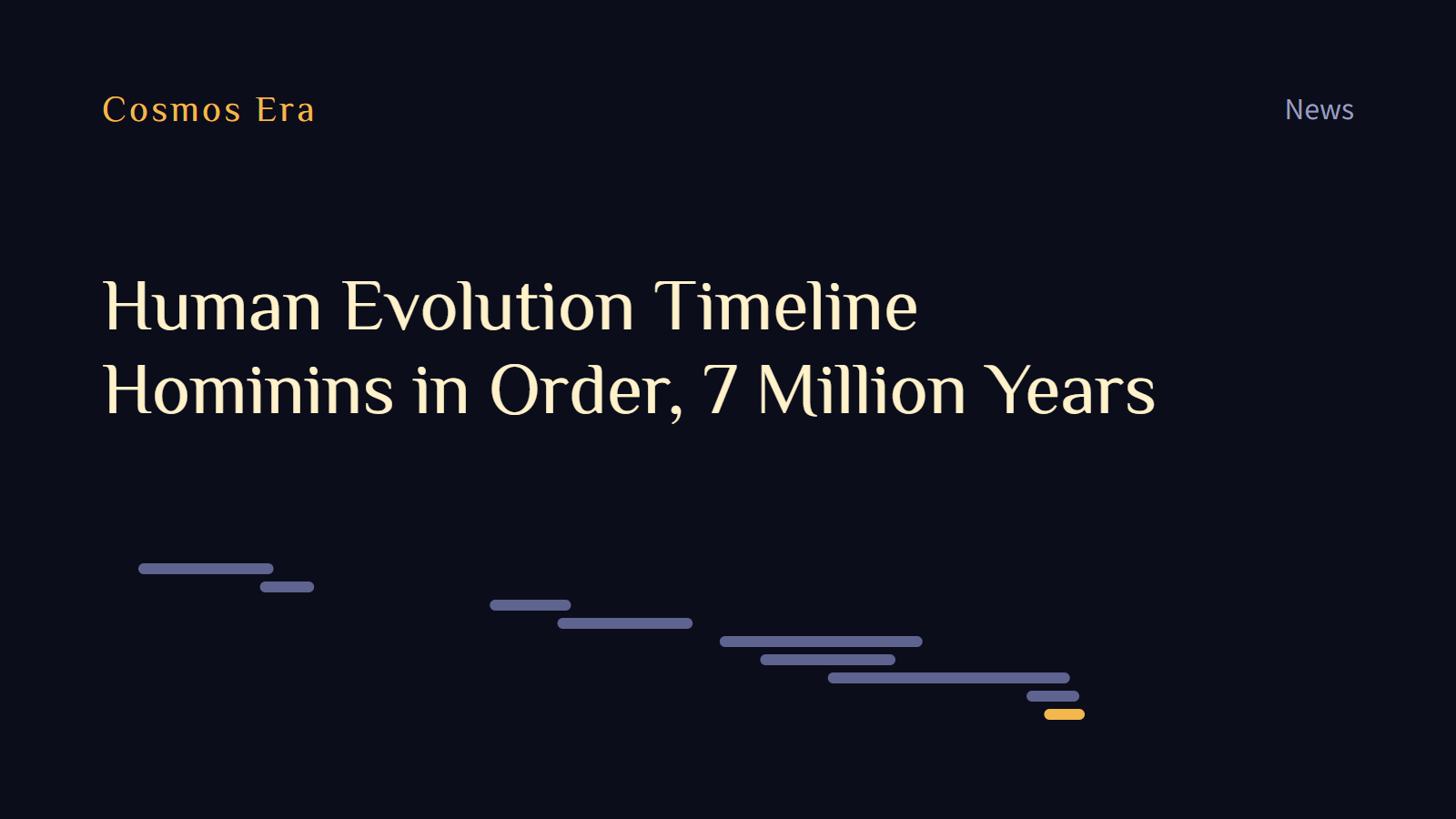
Human Evolution Timeline: Hominins in Order, 7 Million Years
Hominins in order, from Sahelanthropus about 7 million years ago to Homo sapiens: dates, fossil sites and key finds in one table, plus hominin vs hominid.
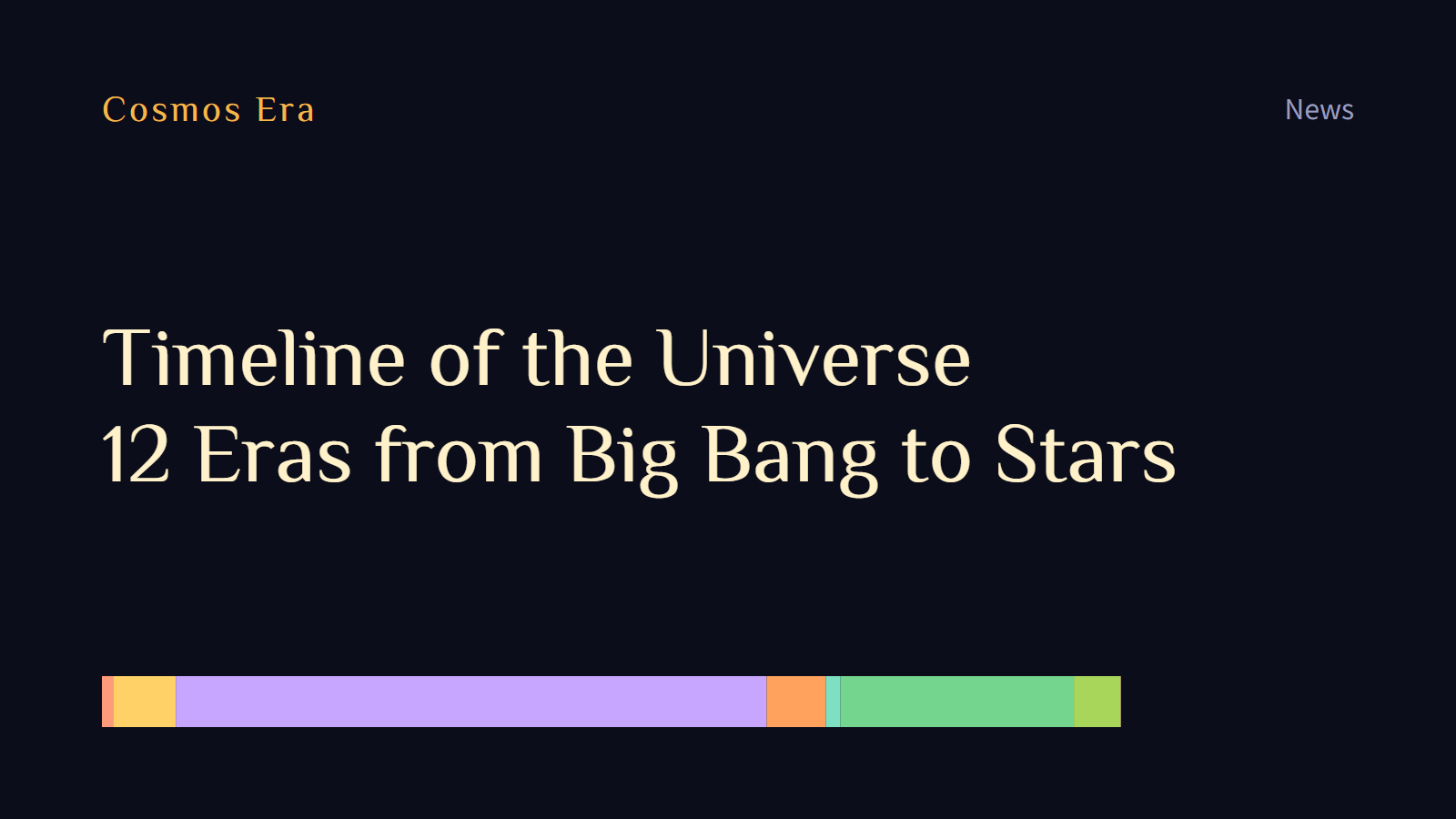
Timeline of the Universe: 12 Eras from Big Bang to Stars
The universe's 13.8 billion years in 12 eras, from the primordial universe and particle era to life and civilization, with cosmic calendar dates.